Maximising reliability, preventing downtime and reducing maintenance costs
The Challenge
An international operating company with assets in the UKCS was seeking a solution to help them maximise reliability, prevent downtime and reduce maintenance costs. Their specific objectives included:
- Establish holistic surveillance capability as part of their daily operations workflows
- Visualise and analyse all data across process, systems, rotating equipment and ancillaries
- Automatically detect anomalies, anticipate threats and take action before problems occur
- Reduce time and resources spent on data analysis, modelling and investigations
- The operator also wanted a solution that could provide accurate and contextualised outputs, without false alerting and deliver quantifiable impact in weeks.
The Solution
As an existing customer of OPEX’s solutions, the company implemented X-PAS on a gas compression system on one of their assets to evaluate the approach against the required objectives.
X-PAS is an application which leverages engineering expertise together with artificial intelligence and has been designed to overcome the technical challenges associated with unique complex assets as well as dynamic day-to-day operations and constraints.
X-PAS encompasses:
- the aggregation of all relevant data including CRO logs, asset reports, process, equipment, condition etc.
- creation of a digital hierarchy of the asset including system, sub-system and down to each instrument
- a range of AI and statistical analysis techniques to derive and understand correlations within the data
- an encoded process to continuously identify and contextualise anomalies and changes in system health
- a method of baselining deviations with operational relevance to the target system and the possible operating modes, configurations and constraints but without bias from historic events or performance
- in-built workflows to facilitate prioritisation, focus, decisions and actions across the organisation
- a framework to bring all of this together, automate data analysis and provide visual outputs to the user
The easy to use software application provides the customer’s teams with the ability to make fully informed decisions and take proactive action to maximise reliability and prevent downtime.
The gas compression module was customised and configured over a 4 week period. Following go-live, X-PAS was rolled out by asset support teams with some 47,000 data relationships under continuous analysis.
The opportunity
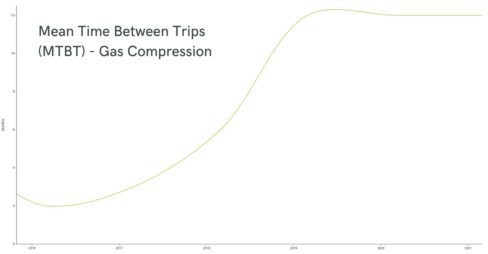
Analysing historical data from prior years revealed that the target system had a mean time between trips (MTBT) < 4 weeks.
While it is not always practical or possible to prevent all system trips and unplanned downtime, there was a clear opportunity for the customer to improve.
Impact
Over the period from 2016 to date, the operating company has improved reliability, reduced production losses and realised maintenance savings summarised below.
MTBT: >12 months
Reduction in System Trips: >75%
Production Losses Avoided: >$20m
Maintenance Savings: $796k
The customer's asset teams can auto-detect anomalies and anticipate potential threats and vulnerabilities before they occur (most of which were previously unseen), subsequently making operational changes or taking action to maintain or improve reliability.
With X-PAS integrated as part of their daily workflows, the company is able to continuously identify and take actions to maximise reliability, prevent unplanned downtime and realise cost savings through a predictive maintenance approach.
Following successful implementation on gas compression, X-PAS was rolled out to all of the other critical systems and subsequently to the rest of the operator’s offshore assets.
As a result of adopting X-PAS, and the improvements being made to reliability, the operator is helping to drive productivity with multiple benefits across the organisation:
Asset Management can maximise asset reliability and prevent downtime as an integral part of daily operations without additional resources or initiatives.
Process Engineers are provided with deep situational awareness and extended capabilities to prevent process upsets and optimise key operational processes.
Reliability Engineers are able to understand even more about their assets and proactively prevent system trips and failures without the burden of complex data analysis and modelling.